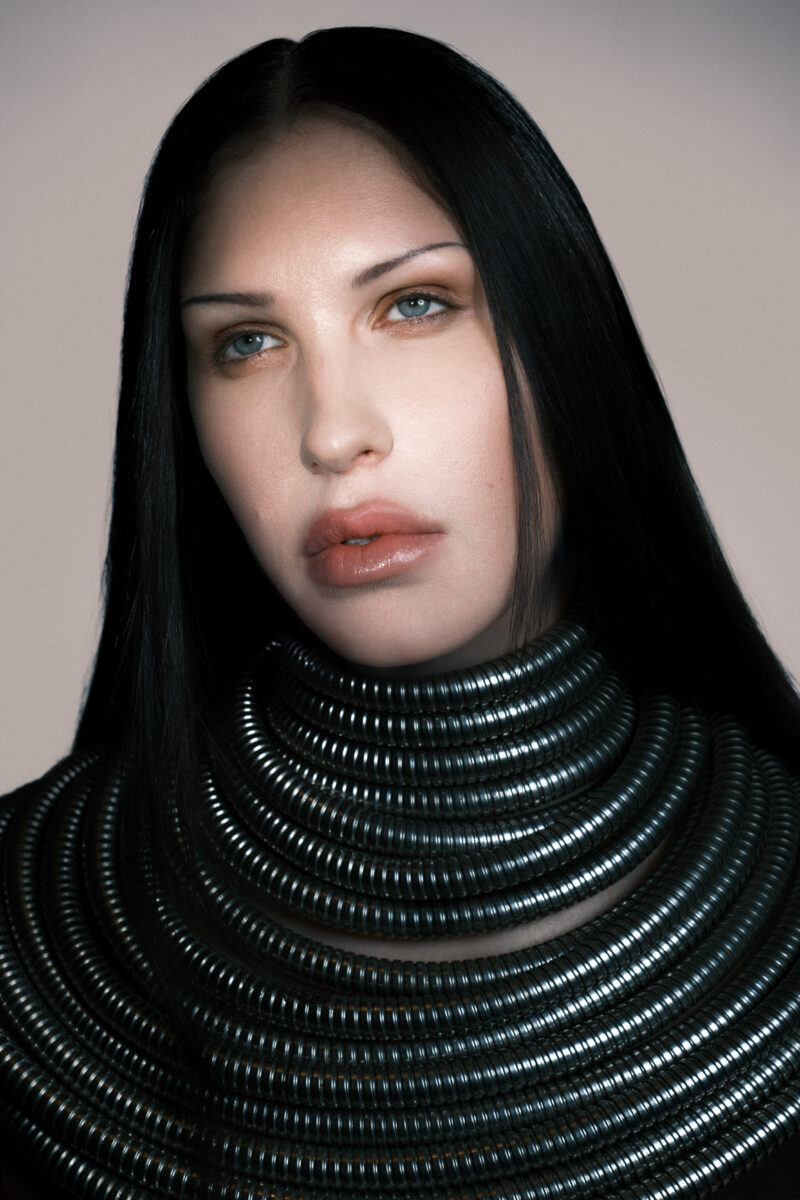
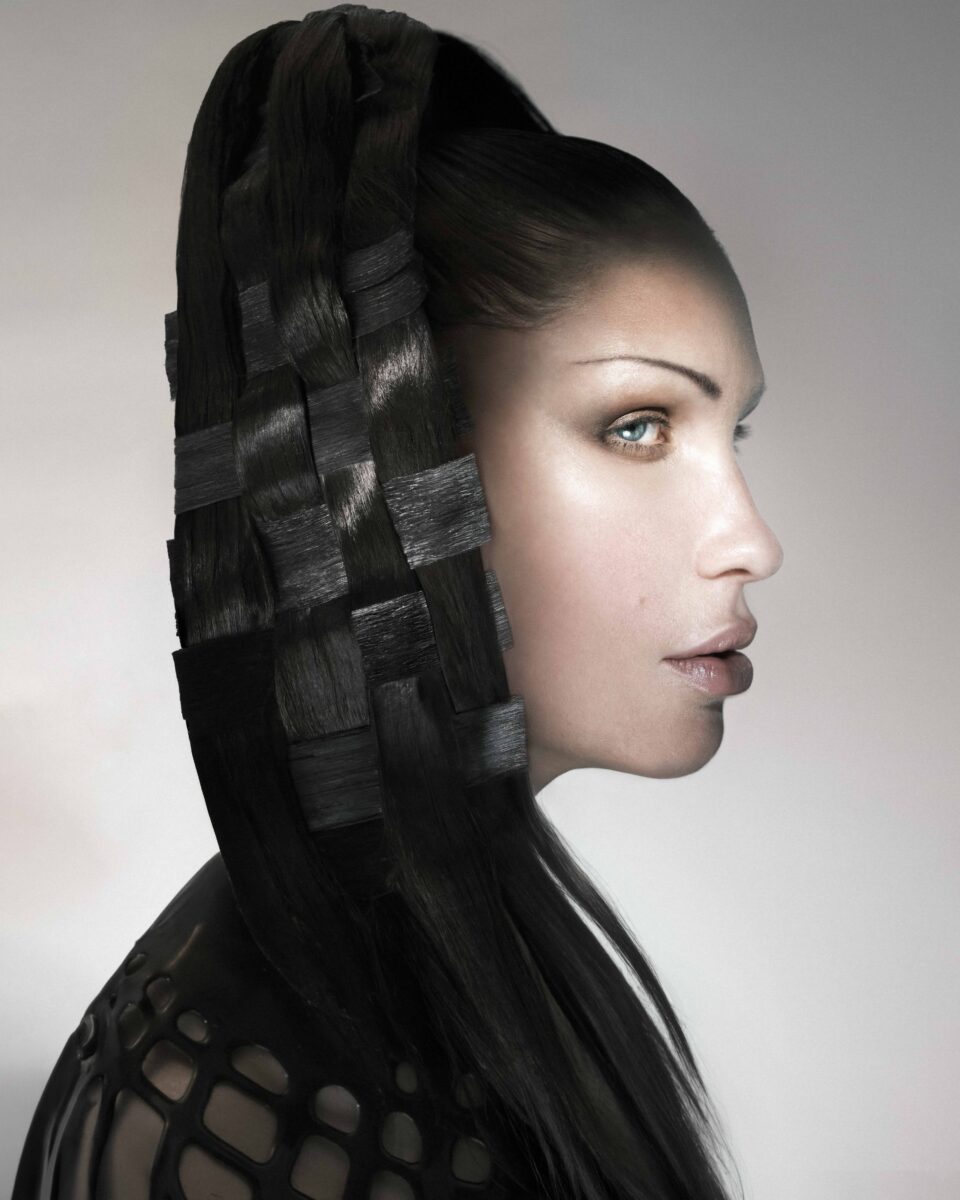
Motherhood transformed the 37-year-old experimental pop musician. On her latest album, Eartheater chronicles the pains, pleasures, and earthly delights of motherhood, pregnancy, and life.

When I speak to Eartheater, she’s just finished putting her newborn daughter, Novishinka, to sleep. She’s been busy – juggling a role as a full-time new mother alongside an album rollout – yet she remains graceful, at ease, ebullient. If anything, between the two of us, it’s me who’s all over the place. Early on in our conversation, I trip over my tongue when trying to say “brutal” and “magical,” spouting out instead an odd hybrid “brutical.”
Eartheater latches onto the word, and, in her generosity, my faux pas suddenly sounds far more interesting and purposeful than it previously was. “Brutical is a very cool word,” she says. “I think we should go with that.”
Brutal and magical – one could say brutical – describes the experimental art-pop artist’s music and her early memories. Born Alexandra Drewchin, the 37-year-old musician grew up on a farm in rural Pennsylvania. In the empty space surrounding her, she learned to let her imagination run wild, to fill in the gaps of quiet with wild visions of nature and imaginative dreams. She recounts one of her earliest memories from childhood: when her younger brother caught a big-mouth bass in the family pond, quickly gutted it before her eyes, and placed its still-beating heart in the palm of her hand. “I’ll just never forget that, like holding the beating heart,” she says. “It was a brutal, magical, metal-ass moment.”
Heavenly Body: If I’m The Bottle You’re The Message, Eartheater’s latest album, shared on 14th July, returns to this childhood site, but more importantly, it documents Eartheater’s own journey into motherhood. The single “Paradise Rains” recounts, over a lush bed of strings and pattering raindrops, the story of buying back her old family farm and conceiving her newborn daughter, Novishinka, on the very same night she and her husband went to first visit the party. It’s a story of fate, the strange way that the past often intertwines with the future.
Novishinka’s presence shapes the album. Album opener “Malka Moma”, for example, is based on a traditional Balkan song that Eartheater listened to during Novishinka’s birth and early infancy; “the first song on my birth playlist and the first song on my nursing playlist,” as she describes it. Much like the way a baby learns language, the song absorbed and moulded itself into her consciousness. “I listened to it so much that I could sing it, even though I didn’t even know what I was singing,” she says. “I knew the whole song before I ever even looked up what the lyrics meant.”
Elsewhere in Heavenly Body, though, Eartheater can be visceral and vicious about the equal pains and joys of pregnancy. “Glowing Guts” is unflinching yet beautiful in its depiction of pregnancy, with lines like “Body distorted and puffed / Catch myself in the mirror / Heart burning with acid and love.” For Eartheater, the song represents the “implosion of comfort and predictability in your body when you’re pregnant.” “Or when you’re going through labor,” she adds, “it’s an avalanche or it’s an earthquake happening inside you, and you can’t do anything about it except to ride it out.”
Yet, even amidst the pain, bright spots always arrive. Eartheater describes being influenced by the Japanese philosophy of wabi-sabi: the beauty of imperfection, of things that are broken and proudly patched back together. For Eartheater, pregnancy and motherhood are all about experiences that stretch you out to your breaking point, push you to the limit, and break you more than you’ve ever known – only to offer you the beautiful, life-affirming chance to piece yourself back together and realise for the first time just how strong you are.
In that sense, “Don’t Look Back” is the wabi-sabi counterpart to “Glowing Guts,” an anthem about moving forward, healing, and having faith in the future. Alongside wabi-sabi, Eartheater found herself influenced by the theory of a non-linear conception of time during Heavenly Body’s creation. “The future has already happened,” she reflects. “And it’s about having faith that what’s already happened was in our greatest performance to get there.”
Despite the difficulties of motherhood, Eartheater has also found it a source of inspiration and motivation like no other. It’s a total jump-starter: “jet mommy, jet fuel in my ass”, as she says. Though she was carrying Novishinka during a large portion of Heavenly Body’s creation, Eartheater confesses that it was the quickest album she ever worked on. “My relationship with time has completely transformed” since having a baby, she says. “I just seize time when I can because there’s just less of it.”
This same logic applies to “Fast Asleep”, Eartheater’s collaboration with French electro-pop artist and fellow recent mother Oklou. She describes the track as the “easiest, most streamlined, just easy breezy collaboration” she’s ever worked on: she told Oklou what the song would be about, Oklou said she loved it, and soon enough Eartheater had vocals in her inbox. “I think she recorded the vocals in her tour bus,” she laughs. “And she got them back to me super fast. It was like, Okay, wow, moms are so… we get shit done quick.”
Since releasing Heavenly Body, Eartheater has been, of course, wrapped up in work – promoting her album, touring, and preparing for an upcoming show at London’s KOKO – but she’s also been cherishing the time she spends with young Novishinka. Listening to music together is a special experience; apparently, Novishinka loves anything with “a good, squelchy, interesting beat”, and Eartheater has also loved watching Novishinka slowly discover the world. Moments that seem mundane on the surface are, for both Eartheater and Novishinka, filled with charm and possibility; with the deftness of a poet, Eartheater describes how it feels to watch her baby observe a ceiling light: “She’ll just stare at it and then see that when she raises her hand, the light’s on her hand, and then she thinks that her hand is casting a shadow, and you can see her little mind working.”
I ask Eartheater about the recent spate of albums examining motherhood from a new lens, most notably Robyn’s Sexistential from earlier this year, which approaches the often-unexplored subjects of motherhood, IVF, pregnancy, and sex after forty through pop music. Eartheater gushes about the album and about thinking of her work in conversation with Robyn’s. “I wish every mom could write a postpartum album,” she says. “Every mother’s story is so specific.”
As for Eartheater’s story? Well, it’s one about farms in Pennsylvania, the beating heart and guts of a dead fish, a daydreaming girl full of imagination, pattering rain, an obscure Balkan choral piece. It is, like any great story of motherhood and family, about love.
And of course, because Eartheater is Eartheater, her take on motherhood is unlike any other. When Eartheater reflects on Novishinka’s early newborn phase, she describes herself as “basically an indentured servant for a tiny little puking, shitting, adorably cute dictator.”
“Or just a dom,” she laughs. “Like my baby was domming the whole world at that moment. I was her hand and foot.”
I laugh too. I tell Eartheater that she’s right; I’d love for every mom to write a postpartum album. It’s true, every mom’s perspective on motherhood is so different. After all, how often will you hear someone comparing a baby to a dom? But of course Eartheater could make that imaginative leap: count on her for a raw, brutical vision.
Listen to the album…
Words – Lydia Wei
Photography – Vidar Logi


