Located on a beach in the Faroe Islands, G! Festival successfully unites local heritage with thrilling world-class music for a unique and euphoric summer party bathed in Nordic light.

It’s half midnight in the Faroe Islands. The indigo twilight stretches endlessly above, so vast it makes the volcanic landscape and the seaside village of Syðrugøta nestled within look like a toy town beneath its infinite expanse.
Does anyone have a recent Swedish pop star’s hit single at hand?
I stand underneath the lingering midsummer light, this sprawling banner of sky and stars. My fingers drum my hips: my last cigarette was smoked a half hour ago. The breeze is gentle, the air impossibly pure. A drunken man in a seaman’s sweater has just almost knocked me over.
I’m at the Faroe Islands’ annual G! Festival, a three-day music event as eccentric and majestic as the landscape itself, a treeless terrain that rolls up and down the horizon with the fluidity of water. The line-up particularly spotlights the young and the beloved of the Faroese music scene, but has previously included the likes of Faithless, Sister Sledge, and Fatboy Slim. This year one of the star attractions was Tommy Cash, of Eurovision fame. On the last day, the day of his set, I watched him step out of the small building allocated to feeding the artists and delegates, to a small gathering of teenage girls. “Tommy!” cries one in a fair isle knitted sweater. It’s something of a festival – if not, assumedly, year-round – uniform. “Can I get a pic for my sister?” Are you a fan yourself, I ask. “Not really,” she trilled. She was just happy to be involved.
“Everyone comes to G! Festival,” another young woman tells me on the first day of the festival. We’re standing in the middle of the audience at one of the stages – a football pitch – whilst singer-songwriter Dan Olsen is performing. The Faroese-born, London-based musician has been given an opening day 6 pm slot, which in these islands feels like midday. His indie-folk sound is warm, melodic, even perhaps nostalgic. There’s a soft Atlantic breeze under a weak summer sun, and I watch the beaming, beer-clutching crowd singing along.
Well, I know the festival was sold out – teenagers work shifts behind bars, ferry us delegates to our respective homestays (there are no hotels in this 500-person village), chat to each other in high-vis security gear for free tickets. But surely not everyone from Faroe is here, I ask my new friend. That’s crazy. “Almost everyone comes to G! Festival,” she corrects herself, grinning. As the weekend goes on, her words ring in my ears like a folk mantra. It feels like an extended family cook-out, if your family were inclined to set up excellent sound systems across several stages that include a barn and a beach, accented by winding open roads and green mountains that turn purple in the never-ending embers of the sun.
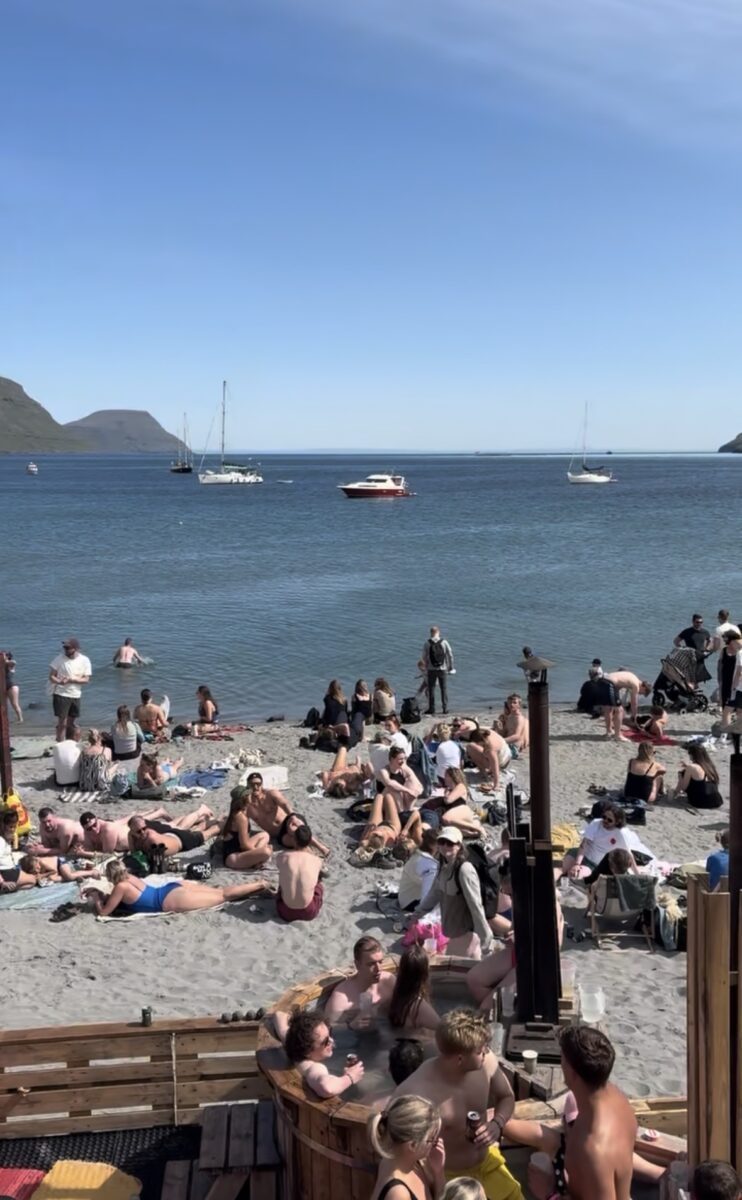
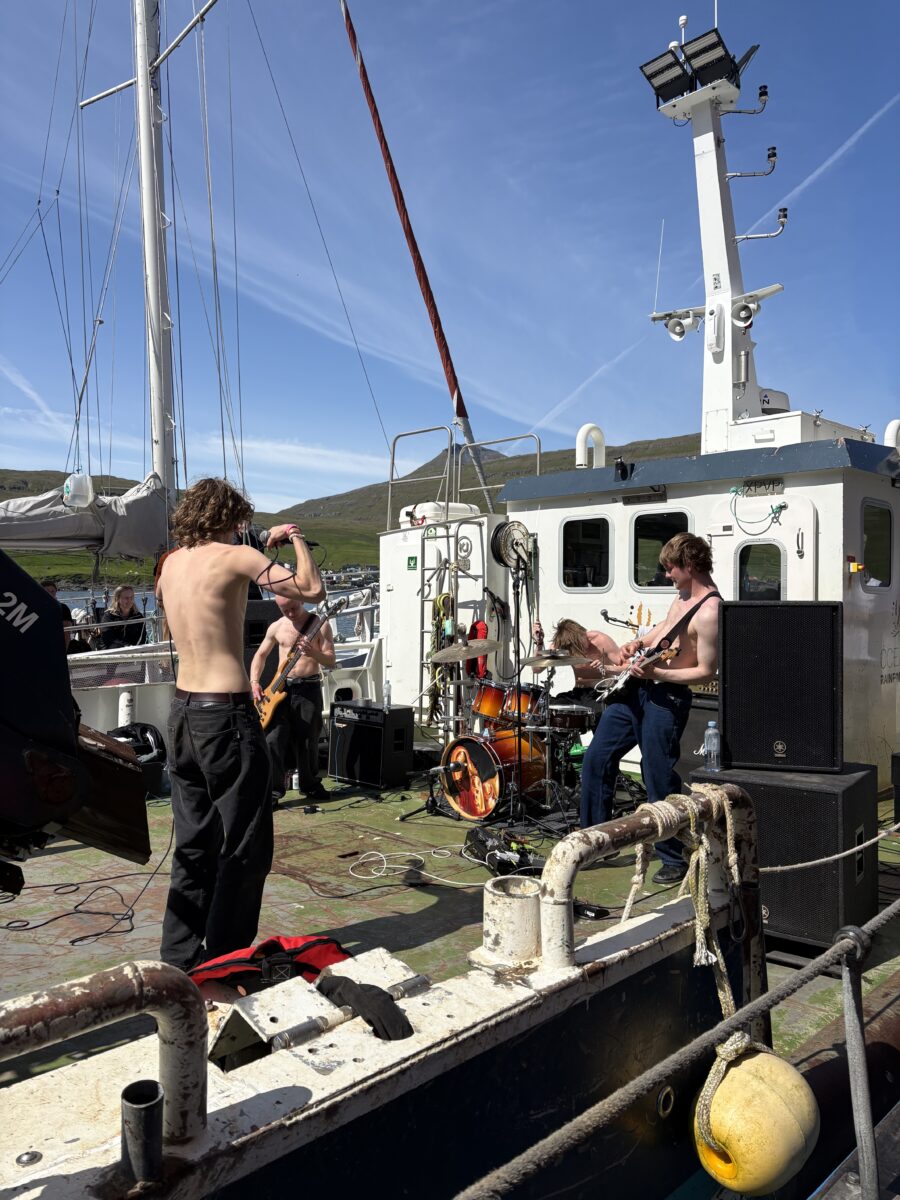

The long weekend flits between whimsical, wild, and at times otherworldly. There are moments I feel like I am in something akin to an animated Disney film. Between the acts, teenagers flirt, young people dance, older locals laugh, and children frolic. We get very lucky with the weather, the locals say. The sun hangs in a cornflower blue sky for hours; it’s a temperate fourteen degrees, and before the music starts up at 5 pm, young people sunbathe, run into the North Atlantic ocean, spread across the beach. Later, they’ll congregate on the same sands once more to jump to young local legend Marius DC. The 22-year-old rapper is witty and wired, pulsing with energy, erudite beyond his years. His sound, while wholly unique, performed in both Faroese and English, also places him firmly within his generation’s zeitgeist: imaginative and quick, wickedly confident, thrilling in stage presence, introspective in songwriting.
It’s a tired cliché of music journalists to write that we “caught up with” an artist after their set. You’ve just asked three questions! But at G! Festival, where artists move within the understandable – and yet from a London perspective, utterly delightful – camaraderie of community, I find myself deep in conversation with Marius. Out here, artists and locals, industry delegates and international visitors – predominantly from Nordic countries themselves – mingle together without boundaries, like some sort of music utopia.
“For so many of us this was our first real festival,” he says. “Our first experience with international artists, our first experience of just how diverse and exciting the Faroese music landscape is. I think the reason G! especially stands out to visitors and outsiders is because of how deeply embedded Faroese culture is in every element of the festival.”
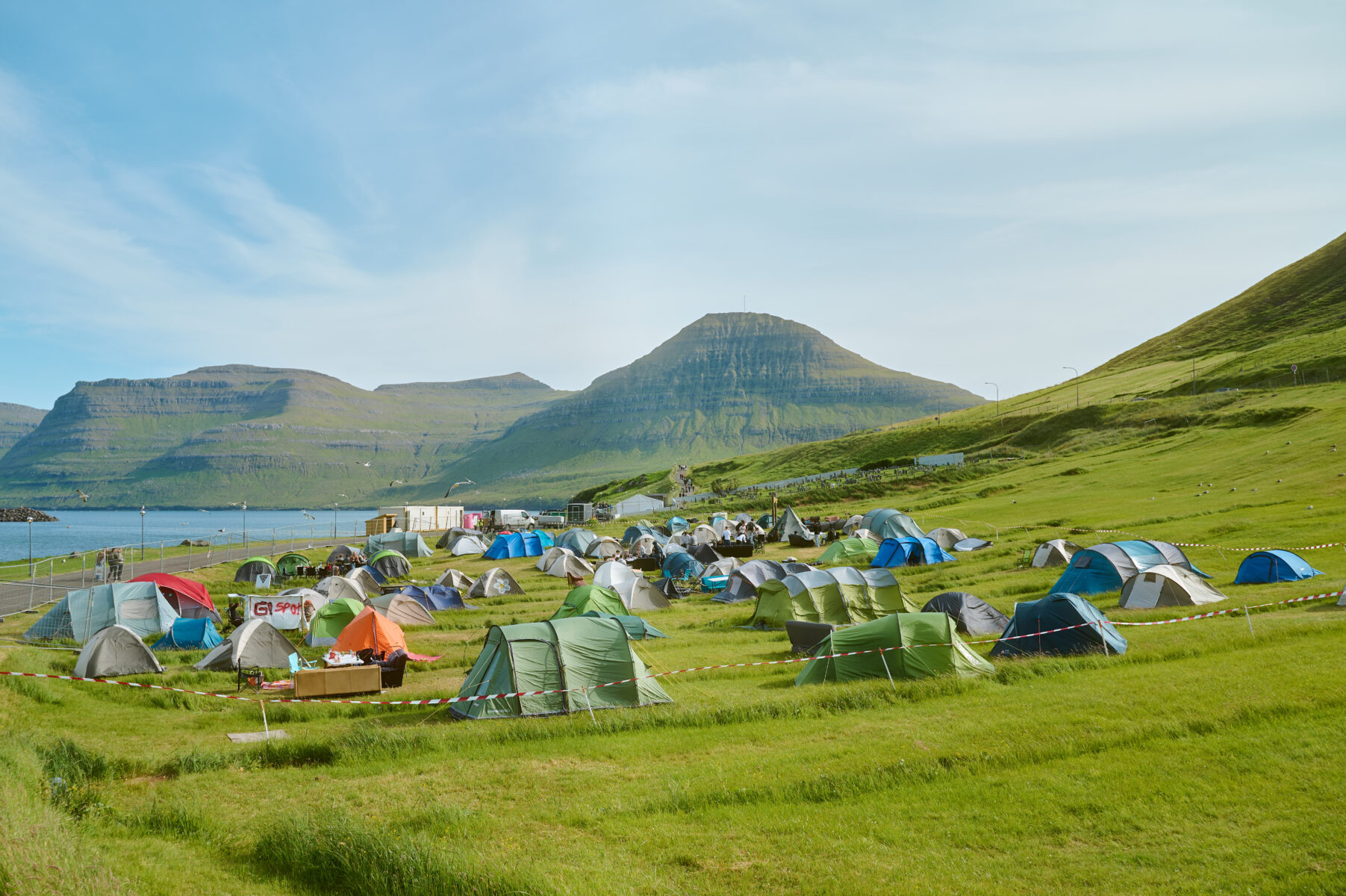
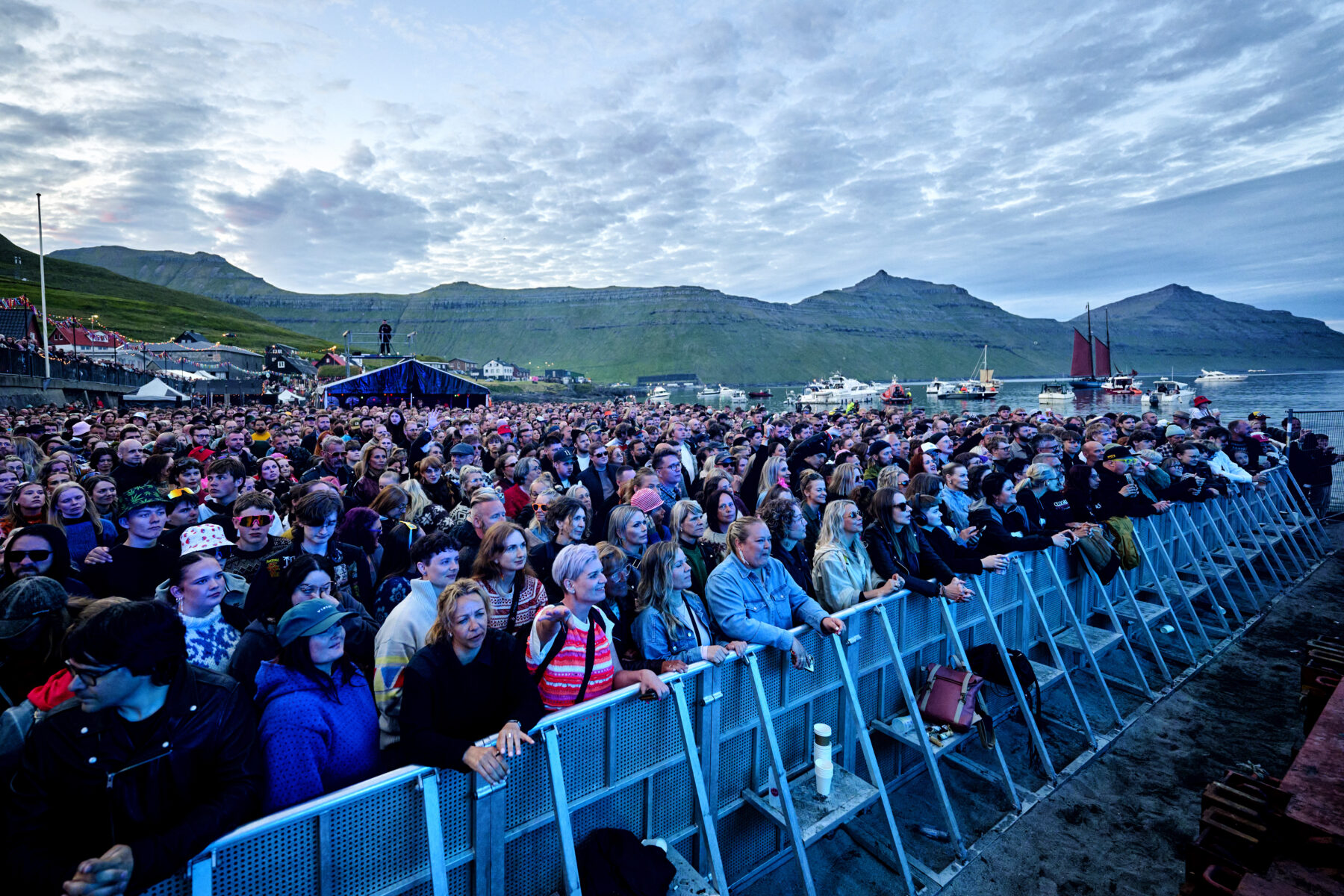
From vendors of fresh sushi to stalls selling knitted goods, this isn’t a festival that is trying to be something it’s not. It’s a difficult balance to strike: how do you host a modern festival every July for international acts and audiences, without compromising on the centuries-celebrated traditions, the deeply cultured local aspects that make it so magical to begin with? At G! Festival, there is no tension between the two. We can party in a shed to this century’s club hits, ricocheting from Rihanna to Euro pop, while artists that have come to define the unique Faroese sound unite the festival once more an hour later. G! Festival doesn’t ignore the world stage, nor does it trip over itself trying to dilute its identity for mass appeal. Instead, it wears its culture and history, its quirks and customs, with pride that comes with a wink. Unlike many other European music festivals, G! has seamlessly found its own rhythm between the two, and it’s all the more exhilarating an experience for it.
For another night, we’re back on the beach, swaying to Eivør. While Dan Olsen is a great addition to the soft rock canon, and Marius DC presents a sound that could bounce from a London party to a New York club, Eivør’s cinematic Nordic folk is haunting, sonically ethereal, chilling as the ocean. I won’t be the first to draw a parallel with Kate Bush and Björk. On the last night, she reunites with her former band, Clickhaze, 23 years after the band last performed together, right on that very beach. It’s powerful for those new to the islands; it’s obviously touching to those who grew up listening to Clickhaze; it’s myth-building in real time.
Someone told me this is a great place to grow up; your child can disappear for the afternoon and you know they’re safe. As I drink wine on the pier with some new mates from the international delegation, warm in the sun, buzzed from the jubilant atmosphere, I feel the pull of island life wash over me like the lapping of the ocean below.

It would be easy to patronise this corner of the world. Kind and generous, they don’t even lock their doors at night. Everyone knows everyone. To those of us raised in big cities, this culture feels like stepping into a long-gone myth of pastoral legend. Honestly, if the Faroese weren’t so goddamn kind, you’d feel quite left out.
And yet kind does not always mean nice. Thank god. The weekend takes place over the World Cup finals, and my Jude Bellingham phone case is an immediate conversation starter. One night, I find myself at a house party. For at G! Festival, around midnight, the houses that line the festival open their doors to a prepared buffet and beers, a customary shot of aquavit. The tradition of welcoming people in with a shot is called dørsnaps, and in this house, it is a guy in his early twenties who greets us into his grandparents’ home.
“Heeeeey Juuuuuude,” he chants. “There’ll be no fucking rowing in New York! Ha!” It’s a good chant, I say. “Not good enough to beat Argentina though, is it,” he counters cheekily. “Go on then, have another shot.” An animated Disney film with a script written by The Inbetweeners lot, then. We laugh and talk about football a bit more. My friends gather around the kitchen table and try whale with the grandparents for their first time. Outside the kitchen window, the dramatic coastal terrain remains omnipresent, towering above the revelling partiers, ancient and watchful. Inside, we European journalists, international music delegates, grandparents and their adult grandchildren, their friends and neighbours. We cluster together, cheering to the moment, making plans for tomorrow.
Words – Bea Isaacson
Photography – Lasse Lagoni, Tomas Galik, Florian Trykowski


