With Benny Safdie’s The Smashing Machine hitting UK cinemas tomorrow, Emily Blunt tells Features Editor Ben Tibbits what drew her to the project, her transformative co-star Dwayne Johnson, and the divisive yet misunderstood woman she portrays, Dawn Staples.

The Smashing Machine is a film built on new experiences. The biographical sports drama’s director, writer and editor Benny Safdie, for instance, was provided with an inaugural opportunity to helm a project alone, following his now cult favourite collaborations with his brother Josh: 2017’s Good Time and 2019’s Uncut Gems. For M.M.A. legend Ryan Bader, the A24 project marked a first foray into acting – a bold step into the unknown from which he leaves with the promise of a burgeoning career in the screen industry. And as for the film’s titan-of-a-lead, Dwayne Johnson, it is the opening address of his re-introduction. He is not the ‘The Rock’ here; no, he’s a thespian with emotional acuity, physical dominance and technical depth. The Oscar bells are chiming.
Behind this revolving door of new openings lies one constant. A grounding force, a seasoned virtuoso, a consistent performer who has long established herself as one of Hollywood’s most eclectic and evocative leading ladies. For Emily Blunt, the role of Dawn Staples isn’t a first. Nor is it a second, or a third. Hers is a 20 year tenure, encompassing a plethora of genres, moulded by the objective of pushing boundaries and cemented by various iconic portrayals – from an Oscar-nominated turn in Christopher Nolan’s modern masterpiece Oppenheimer to owning the job thousands would kill for in A Devil Wears Prada; from achieving action heroine status in Sicario to horror royalty in A Quiet Place. And whilst this role may be just the latest floor in a growing tower of triumphs, it sits at Blunt’s career summit.
“I think sometimes the unsung heroes are the most exciting. The people who are white-knuckling it through life, who are struggling,” Blunt tells me in a hotel in Embankment. She’s in London to promote The Smashing Machine, alongside the “ridiculously brilliant” Safdie and long-time friend and Jungle Cruise co-star Johnson. The night before our rendezvous, the trio surprised a packed Odeon Luxe West End at an early glimpse of their new picture, introducing the screening to a room full of press, industry figures, and family and friends. The pit stop was the latest checkpoint in their victory lap for the film, which premiered in competition at the 82nd Venice International Film Festival, with Safdie taking home the Silver Lion for Best Director.
Opening in UK cinemas today (Friday 3rd October), the film is set to be one of the cinematic events of the autumn. Based on a 2002 documentary with the same title, it documents the triumphs and tribulations of M.M.A. legend Mark Kerr, depicting real life happenings in his life as the sport found its footing on the global stage. Nowadays, sports biopics come thick and fast to varying degrees of effectiveness, but Safdie’s film refuses to follow the style’s played out generic narrative. This is a film less about sport and more about the people involved – whether that be Kerr himself, his coach and competitor Mark Coleman (Bader), or his girlfriend, Staples, whom Blunt plays with ferocity and vulnerability in coalescence.
The film is an illustration of addiction, of love, of mental and physical wellbeing, told with earnest care and rich humanity by Safdie, and played with a sharp and unyielding empathy by its two leads. Johnson is unrecognisable – figuratively and spiritually – in his best ever performance, whilst Blunt acts as his perfectly imperfect counterpart; supportive yet troubled; divisive and utterly compelling.
Below, Blunt delves into The Smashing Machine – explaining her journey to involvement in the project, her symbiotic on-and-off-screen bond with Johnson, the brilliance of Sadie, and why championing the misunderstood Staples lay at the core of her cinematic ambition.
Watch the trailer…
Read the interview…
Firstly, the key question – why this film?
I think the people and the stories that can offer a mirror rather than an escape are really exciting to me. They’re certainly exciting to Benny [Safdie]. He saw that documentary [The Smashing Machine: The Life and Times of Extreme Fighter Mark Kerr] when Dwayne [Johnson] brought it to him in 2019 and he was like, ‘What a fascinating person.’ Someone who’s so tender and self-reflective and willing to explore his feelings, juxtaposed with a demolition machine in the ring to the point where it seemed that he had so much pent-up rage that he barely knew what to do with it. This man who was tormented by his own demons and yet was at one point the greatest fighter on earth. And what does that look like when someone loses it all and what’s the path back to peace? Inevitably it’s gonna be a brutal one.
Benny spoke to you about doing the film on the set of Oppenheimer – what’s the story behind the film’s genesis?
Dwayne was the one who initially bought Benny the project, but then it drifted through Covid and everyone had other things to do. Even Benny said to me in the trailer that he couldn’t do it for about a year and a half he was doing his show. But he had not stopped thinking about it. This happens often; you’ve got films in development, stretching it around, trying to make it work. Benny said, ‘You’re friends with Dwayne, right, could you put me in touch with him directly?’ And that’s always really appealing when you lose the infrastructure of like – as much as I love my agent, as much as I love people who help put it together – it’s quite lovely to have the complete through line with just the creative. I watched the documentary that night and I called DJ and I said, ‘Put a fucking jet pack on and run to do this movie. This is you, you have to do it.’
It is such a transformative, impressive role for him.
It was astonishing.
When production started and you were on set together, was it an immediate switch from Dwayne to Mark or did you witness him growing into this character?
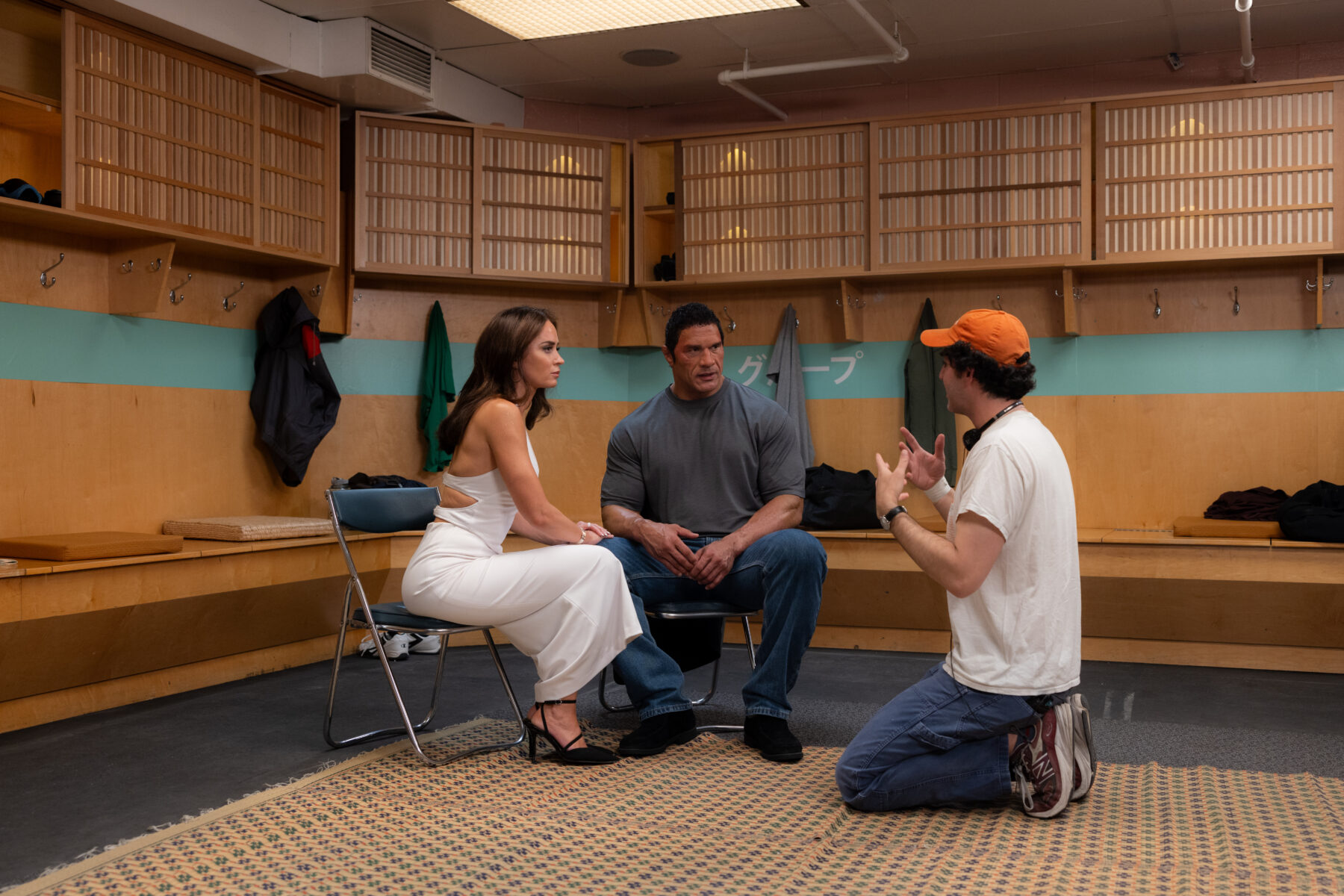
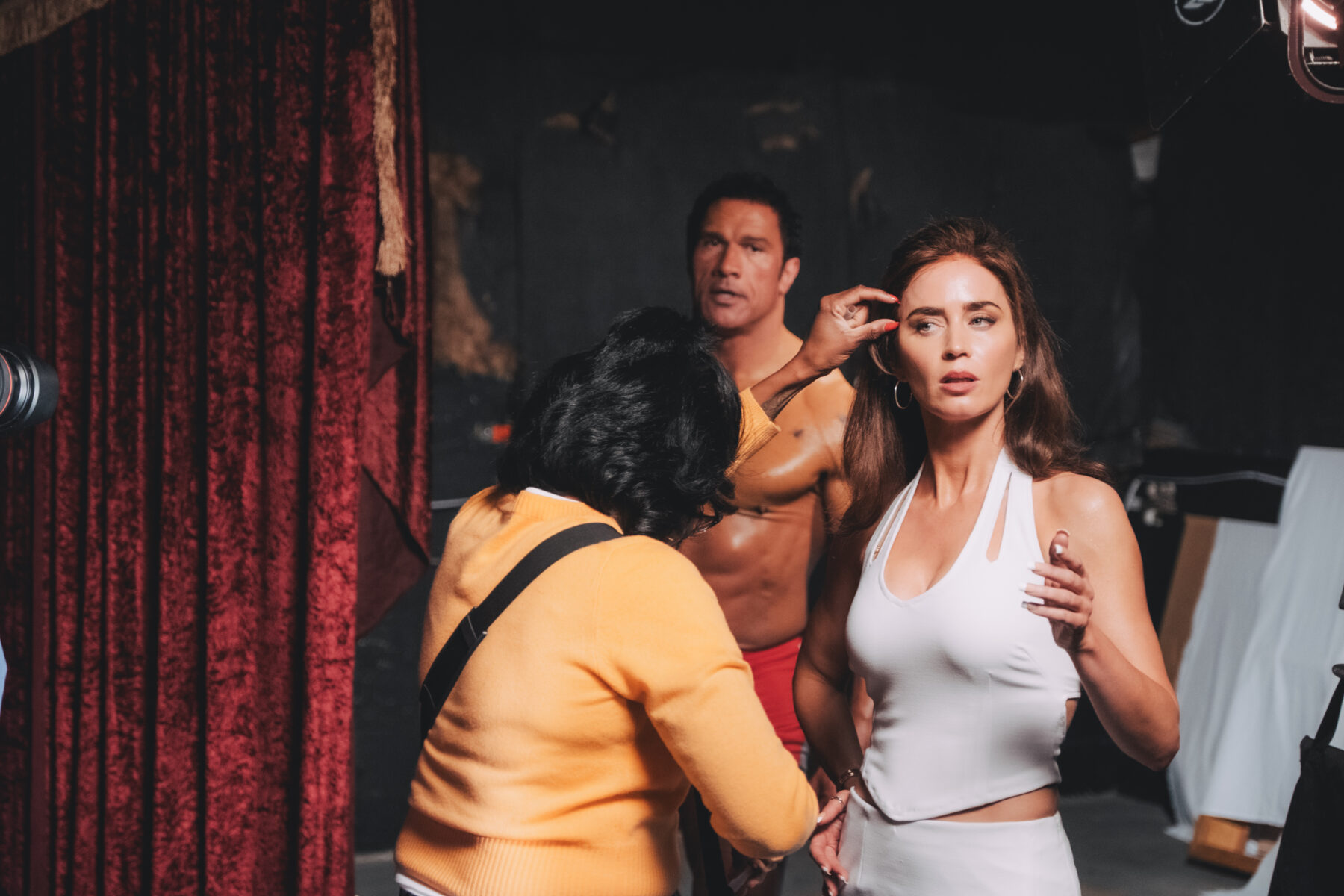
To be very honest, it was the most eerie, immediate switch I’ve ever seen. It was not like watching someone trying to find their footing as this other person. I think he’d just been observing him, watching him for so long. Dwayne’s a very curious person, and he’s an amazing listener and absorbs people with a lot of nuance when he gets to know them. All of his insane people watching skills were on full display as soon as he first walked in for the camera test. It was spooky, it was wild and it was seemingly effortless. I had this feeling, this sense of relief washing over him to disappear, to not be The Rock, to not be a persona, to not be invincible. I could see it within him, this peace, this wholeness to get to do a whole other thing. It was actually just really beautiful.
Why do you think it took so long in his career for this kind of role to come about?
We’d talked about this for years. I’d give him shit about it. He had this phrase he’d always say: ‘Audience first’. And I’d say, ‘I don’t believe in that. I don’t think that’s true, that you have to offer people escapism to put them first, or just offer them something easy and to have a good time. That doesn’t necessarily mean that they’re coming first. I think audience first can also be an invitation to really explore all of yourself so that they see themselves in you and they go away feeling a sense of being seen. That also puts them first.’
We’d have this endless discussion about it and he knew that I had been feeling over the last few years this restlessness in him. He’s always been such a good friend to me and curious about what I’m doing, but wants to know and listens. I could see him wanting to grab purchase of that for himself. And I think when you have an experience like The Smashing Machine, you’re so fed by it. He’s just had the Sunday roast of all meals on this, and now he never wants to go hungry again. It doesn’t mean that he’ll [stop doing his other movies]. He’s doing Jumanji, he’s got Moana. He loves those movies as well. And I love those movies. I think you can do the full spectrum.
Do you feel that you’ve had that part in your career? A role that you would maybe say was your awakening to be like, ‘Oh my God, I can do anything.’
I don’t know if it was one role that was an awakening, because I think I understand and I’m grateful that I have not had the same pigeonholing that he has. So it’s not a tale that I’ve had to shake. I’ve been allowed to have a lot of those moments of like, ‘Oh, I didn’t know I could do that.’
So talk to me about stepping into this character of Dawn. You spoke with her, right?
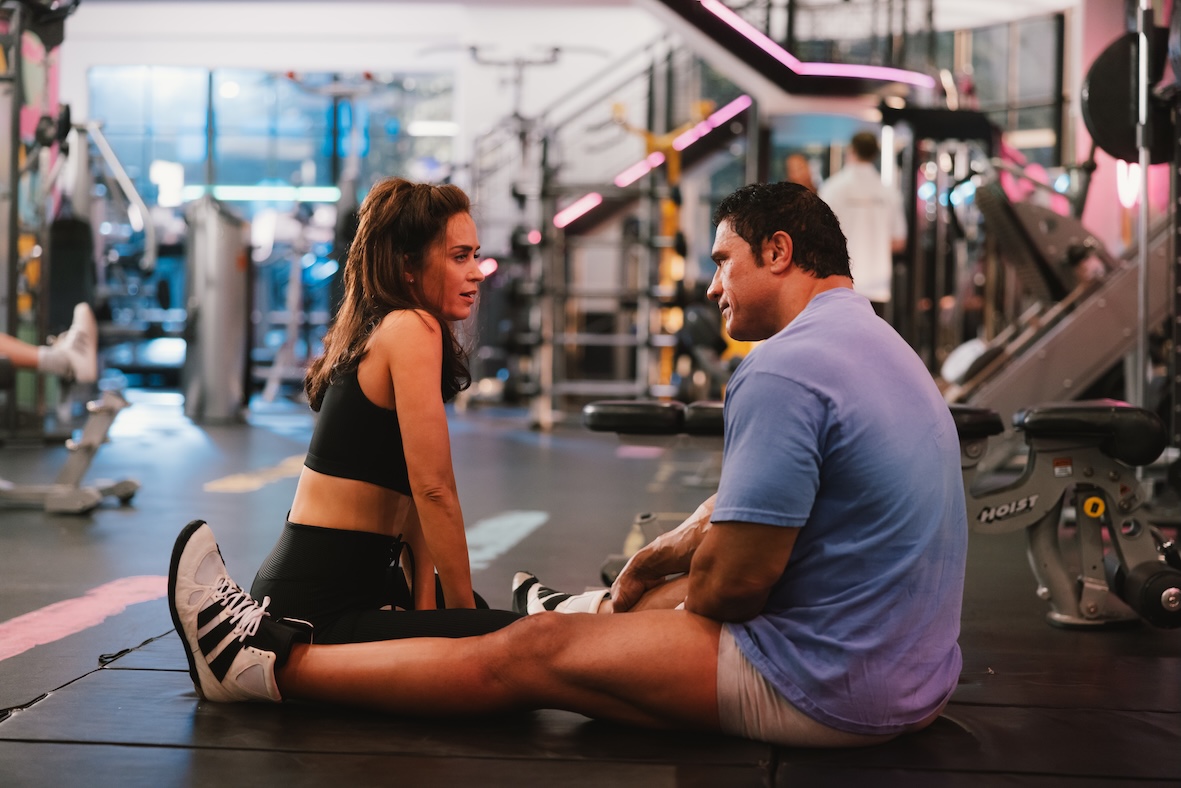
Yeah. She’s incredible and I admire her a lot. She’s as fierce as she is fragile. She’s this myriad of things. I think often in films female characters have to be a little more palatable in their behaviour as a requirement to be held to more of a feminine ideal, especially in a relationship when you’ve got this dedicated athlete, your requirement is to be the catch and the safety net. God forbid you have any feelings about how you’re being mistreated. So it was really exciting that this movie allowed space for this eruptive, rather hazardous relationship that had a huge grounding of love. But they were both tormented by demons at that time, and they both struggled with addiction. They couldn’t live with each other, couldn’t live without each other, and were addicted to that chaos. But it always came back to this love and respect, and to see them hugging in Toronto [find video] was the best. I think the movie’s been quite healing for them both.
When you spoke to her initially, how did she feel about the film? Having a film made about your life must be so difficult in many ways.
I think she was really nervous. When I first got on the Zoom, she was a little nervous, a little guarded. I just said, ‘I respect you. I can’t imagine how challenging it was living with someone like that. I can’t imagine he was impossible at times and I am going to try to be your advocate during a very volatile time in your life. I’ve got you, please trust me.’ And she slowly started to tell me everything and it just meant so much to me. I think she felt really seen, and now she feels understood during that time.
What was your launching point with her? Acting is rooted in the empathy that you can feel for the character, so what was the root of your empathy for her?
For me it was heartbreaking that they were endlessly trying to find this happy medium and it eluded them time and time again. That broke my heart. It wasn’t like she wanted to break up with him all the time and then get back together with him and then break up with him again. It just happened. She shared a lot about her childhood, and then you understand what someone’s marinated in, you understand why they are that way. And then she was lonely. She was on the outside of that brotherhood, that boys club, that system where you are not invited in. You are not welcomed there, but you sure are welcome when he needs you. When win or lose, there’s a fallout, there’s an undoing that happens. Then she was required to be there. That precarious, ‘I need you, I don’t need you, I need you, I don’t need you.’ I think it’s the case for a lot of partners of fighters especially.
I think that the narrative of their relationship is so universal.
Yeah, we might not be as explosive as them, but we’ve all been them at some point and been on the receiving end of that many times in our lives. You know, my brother-in-law Charlie was there last night and he said, ‘Do you want to know what scene killed me? When you walk into the room before the fight [with Kerr and Coleman in] and that energy, that coldness, and no one saying hello to her, Just say hello to her! It killed me.’ But then someone else says, ‘Yeah, but I do understand it because he was trying to focus.’ And I think that’s really exciting that you’ve got these contrary reactions. Depending on what your own triggers are, you’ll watch the film and either feel for one or the other. And I like that.
Or both.
Or both.
On Benny, obviously, I mean, like every film nerd, I’m obsessed with Uncut Gems and Good Time.
Good Time is so extraordinary. Isn’t he ridiculously brilliant in it?
Yeah he’s an incredible actor too. I was so refreshed and surprised by [The Smashing Machine] because there’s aspects of this film that were so signature him – some of the camera work and the editing I thought was really a call back to his earlier films – but then he just allowed the film to breathe so much more than his other work. How was the process, were we surprised about it?
It felt like we were breathing a lot during filming. It was a very collective, familial experience, super, collaborative, very spontaneous. I never saw a camera, don’t remember seeing technical things around me ever. That was so transporting and alarming at times, because it’s high noon in the kitchen when we would go at it, and you don’t feel the technical aspects around you. So it can take you somewhere. But even though there’s no blooper reel, it was a very warm, very loving environment because of what Benny creates. His humanity reigns supreme in this film, as does his empathy and his curiosity in Mark and his story. How he shot it and made it mirrors that – it has respect for Mark. At times, it feels like we shouldn’t be watching him. Like the way you see the wall come in and out [of the shot], as if you’re peeking around, seeing something you shouldn’t. The shot of Dwayne in the elevator on his back, you find yourself trying to see his face. Benny just knows how to suck you right inside the film. You never know how a film’s gonna come together until you see it. But you get a sense when someone might be shooting it very emotionally. There’s shooting a movie and then there’s making a movie. And you knew that Benny was making a movie.
What drew you into this world of UFC? What did you know about it before?
I never watched sports, but I love a sports doc. I don’t know why, but that’s all I want to watch right now. I’ve never watched football. I just watched the Dallas Cowboys one – riveting. And the Michael Jordan one. And then this other documentary that John [Krasinski] introduced me to called In Search of Greatness and it’s incredible if you’re looking for one. It’s Pele, Jerry Rice and Wayne Gretzky, and it’s this beautiful arc about how you might not be statistically the best, the fastest, the strongest, but if you have creativity and if you have passion, you could be the best. That mindset, the plight of an athlete, the loneliness of it and the pressure of it, I really love. They’re putting their bodies on the line, they’re putting their lives on the line. There’s something really gladiatorial about it. I’ve always been interested in it and interested in why athletes do what they do and how they do what they do. So this was like heaven for me to kind of get into that world.
Also maybe there’s a mirroring in that to being an actor, to being a performer.
Maybe that’s what it is that I like, understanding the pressure to perform and be on. I know what that’s like and I know what it’s like where you’re having to be a certain thing, whether it’s in public or a press tour or a movie and nobody knows what you’re really dealing with at home. How you’ve got to live a parallel life sometimes. That’s what our film explores too – you never really know what someone’s dealing with.
Words – Ben Tibbits


