She did the butcher, the baker, the home and the family maker. She thinks the Labubu craze signals a recession and still swoons for boy bands. Dunboyne’s own Diana, she’s the latest soon-to-be-global pop star to grace Glastonbury’s Pyramid Stage – and with EURO-COUNTRY, her sharp, third studio album, she shows us exactly why.
It’s 1.30pm sharp on what feels like Britain’s most aggressive flirtation with summer in recorded history, and a sun-slicked swarm of nearly sixty thousand are making their pilgrimage to Glastonbury’s Pyramid Stage. It’s Friday – the festival’s first proper day of music. But judging by the glistening limbs, psychedelic tan lines, and inch-thick dust welded to every stomping sole, the crowd’s already deep in the Worthy Farm delirium.
For the uninitiated, a quick FYI: coaxing a Glasto-goer out of their tent before 3pm is basically a competitive sport. But scanning the sea of punters, one thing’s clear – only one name on this year’s stacked line-up could summon this level of early-afternoon devotion.
“I am CMAT,” bellows 29-year-old Ciara Mary-Alice Thompson, storming the stage in a cobalt-blue plastic dress, “Dunboyne Diana” emblazoned across her back like a superhero alias. Euro-sign earrings – each roughly the size of her head – swing on either side as she prowls the mic.
“I’ve got middle-child syndrome, an amazing arse, and the best Irish country rock’n’roll band in the world.” Before the crowd has a second to process it, she drops flat onto the stage, feigning a faint, and launches into her melodic ear-sticker “Have Fun!” – still lying face-down, delivering what might be the crispest vocals ever projected from a horizontal position.
Ever the show-woman, ever the dramatist, the message is loud and clear: history is being made before our eyes. Our generation’s next great pop star is rising – and we’re lucky to have shown up in time.
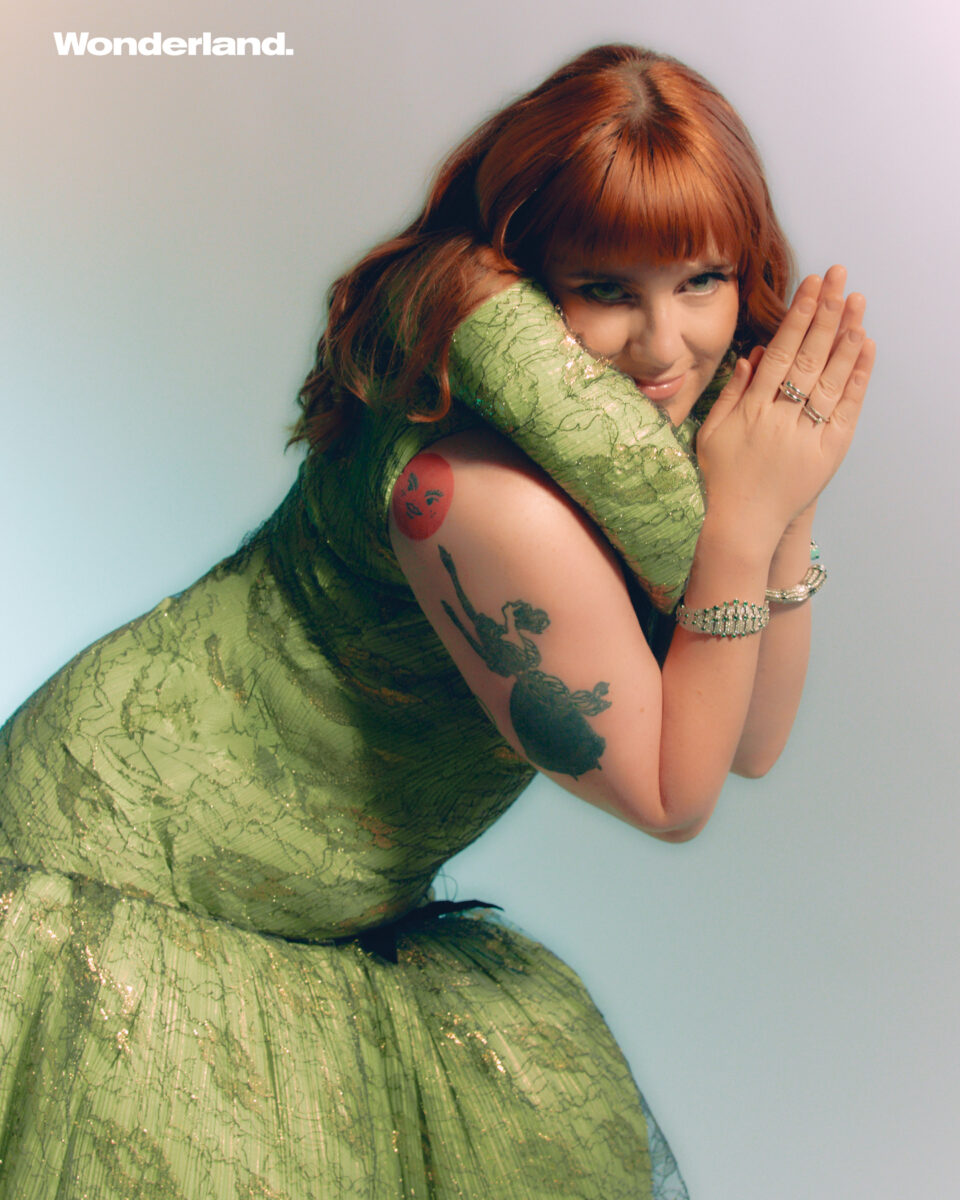
“Before we start, I’d really love a Diet Coke,” Ciara says cheekily, settling into a glam chair in London’s East End ahead of her Wonderland shoot, a month post-Glasto. We’ve just wrapped up a quick discussion on Labubus – she thinks they’re creepy and a recession indicator – and she gently apologises for not making eye contact during our chat. She has a broken toe, and a packed schedule. There’s a brow hair being plucked, a bouncy red fringe being blow-dried into shape, and the sound of my recorder clicking somewhere in the middle of it all. It’s a brief but telling glimpse into life these days for the 29-year-old singer-songwriter: everything is happening, all at once.
“Definitely feeling Freaky Friday,” she laughs, glitter-toothed and direct, when I ask how she’s doing. “My life has changed considerably in the past two to three months in a way it hadn’t before, off the back of how successful the music is becoming. It’s kind of a really weird time.”

In the summer of ’25, CMAT has infiltrated the creative consciousness and playlists of every tasteful ear-holder at the speed of a tropical storm. She’s a fixture on the European festival circuit, drawing thousands to fields across the continent to bougie, cry, and two-step to her infectious, country-tinged, Fleetwood Mac-ian pop anthems. With 2.6 million monthly listeners on Spotify, her track “Take a Sexy Picture of Me” – lifted from her forthcoming third studio album EURO-COUNTRY – became her first single to chart on the UK Official Singles Chart earlier this summer, fuelled by a viral TikTok dance lovingly dubbed the “Woke Macarena.” Her upcoming North American tour? Completely sold out.
“The last time I was home [in Dunboyne, a commuter town in Greater Dublin], three different op-eds in three different national newspapers used my name in the headline,” she says, still sounding slightly bewildered. “I was just like, ‘Why? Why is this happening?’”
To unfamiliar ears, CMAT’s Olympic long-jump from indie darling to headline-maker might sound like a case of overnight success. But for Ciara, the rise is no mystery – it’s the product of years of graft. It could be her relatability – the tongue-in-cheek lyricism (‘Always the cowboy / Never the cow,’ she deadpans on “I Wanna Be a Cowboy, Baby” like a modern poet). Or maybe it’s the camp, activism-charged stage presence in times of political turmoil: “I don’t want people to get the impression that I’m not doing brand deals because I’m real and authentic,” she quips. “I’m none of those things. I would be taking the bag if the bag was even a little bit more ethical and not straight-up just contributing to the absolute worst massacre of people that I’ve seen in my lifetime.”
Before becoming CMAT and signing with AWAL in 2021, she’d been making music semi-professionally since the age of 17 – all while juggling an eclectic portfolio of odd jobs on the side. “TK Maxx was my favourite,” she grins. “I still get a little bit turned on every time I have to hang clothes up because I can do it really quickly.”
Her debut album under the CMAT moniker and label, If My Wife New I’d Be Dead (2022), debuted at No.1 in Ireland – as did the follow-up, Crazymad, For Me, the following year, earning her a BRIT Award and Mercury Prize nod in the process. For the past four years, the pace has been relentless: a hundred shows a year, no days off. Every music video, stage design, band member, costume – she has final sign-off on it all. So what’s the secret to that kind of stamina? “I think I burn out every two to three weeks, and that’s not a joke,” she admits. “Have a little nervous breakdown, have a little cry, and then I just go to sleep and keep going. It’s not super realistic, but I also think that’s the job – that’s the difference between people who become successful and don’t.”

If anything, the Pyramid Stage was the universe catching up. “I campaigned for it, basically. It was the first time I’ve ever really done something like that – telling people what I wanted. I was like, ‘I want to do the Pyramid Stage. Let me do it.’” Was it a bit of a gun-jump, though? “A couple of people told me not to do it,” she grins. “They were like, ‘Go for something else – that’s the biggest thing you can do. Save it for when you’re really famous, on your fourth album.’ And I was just like…we don’t know what’s going to happen. I could stop my career before then, because it is fucking exhausting. Maybe I’ll want to take a break and lose the momentum, and something like that won’t come around again. Who fucking knows? So I was like, I’m doing the Pyramid Stage now.”
Before her performance, she spent months studying the archive – watching how artists handled the Glastonbury beast. “People are always like, ‘Bring in special guests, bring out extra dancers, we need to do something special for the Pyramid Stage.’ And in my opinion, that’s where people go wrong. Glastonbury is already so loaded and so scary – you’re going to introduce an element to your live show that’s not well-rehearsed? I just found that mad,” she says. “We were like, we’re just going to spend all the budget on costumes. Sorry – not the whole budget, more than the budget.”
That obsessive dedication to craft is something Ciara returns to often. “And this is where the cognitive dissonance comes with me, right?” she says, hands in motion. “I love Judee Sill and I love Dory Previn” – a lineage of ’70s singer-songwriters she fell for thanks to a freak-folk-loving music teacher and her sister, who “got LimeWire on the family computer and taught [me] how to illegally download music, which was incredibly important, genuinely.”
She pauses, then adds: “But I also love pop stars. I want to be a pop star. I want to wear a wig and I want to have a shiny dress. And I want to play to a million people in Central Park. Maybe the CMAT project is this fusion of who I want to be and who I actually am.”
Who is that latter person, I ask? “Someone that loves big, fat pop music,” she laughs. “I feel like I’ve spent so long developing my sense of taste. I didn’t go to private school, I don’t have a third-level education or anything like that, and I wasn’t posh. So to build the kind of cultural education I wanted, I had to work really, really hard, just to walk into a place like London and be able to compete with people who’d had all that help. But my commonness always comes through. Do you know what I mean? Because of where I come from, I just can’t not love boy bands, I can’t not love girl bands, and I can’t not be obsessed with Samantha Mumba. I see BTS and my heart skips a beat.”
The day we speak, it’s release day. In just a couple of hours, the title track of EURO-COUNTRY will debut on BBC Radio 1. “I think I’m a lot better,” she says, no fluff. “I’m a much better musician now because I’ve just spent so much time in studios. I’ve made three albums in four years – and that’s a lot of music to make in a very short amount of time.”

EURO-COUNTRY marks a striking gear shift in Ciara’s sonic trajectory – a sharper, more unflinching evolution. The songwriting’s deeper, the soundscape denser. She’s reaching into the marrow of her Irish roots, speaking Gaelic, unpicking the knots of Ireland’s political and financial past and its slow-burn toll on its people. There’s loss, there’s heartbreak, there’s a kind of inherited ache – and through it all, a richer exploration of country music’s backbone, pushed through a distinctly CMAT lens. It’s a record that resists categorisation, a statement piece from an artist who refuses to be boxed into one genre. “I don’t know if I ever set out to make a political record,” she admits. “I guess I was just thinking about it a lot, and then that’s what happened. I think the minute you have a pre-orchestrated intention behind making an album, then it would be bad.”
Before I go, I ask how fame feels. Does she worry about losing what matters most in all the glitter of the British capital? “Not really, because I think that would be insane,” she says, laughing at the irony. “The structure of the London music industry is [wild]. People get signed when they’re really young, and suddenly it’s like, ‘Well, you’re a famous person now – off you go to Soho House.’ There’s a whole texture to what a famous person in London is meant to be. And then you start getting ideas. You get a bit big-headed, thinking, ‘I’m one of the important people now.’”
She shrugs, unbothered. “Listen, if someone offers me a free hotel room, I’m taking the fucking free hotel room. I’m taking it. But you don’t need to post, ‘So grateful to my big hotel room family for everything they’ve done for me.’ You can just take the free shit and move on.”
Pre-order Wonderland’s 20th Anniversary Issue now.
Photography by Hannah Cosgrove
Styling by Anastasia Busch
Words by Sofia Ferreira
Hair by Jessie Whelan
Make-up by Niall Candy
Set Design by Elliott Rooney
Photography Assistant Oliver Matich
Fashion Assistant Ruby Raine
Set Design Assistant Jim Charles
Videography by Lauren Austin
CMAT
CMAT
CMAT
CMAT