Earlier this month, Japan’s hottest duo YOASOBI made their London debut with a blistering showcase at Wembley Arena. Writer Hannah Abraham went down to see what the fuss is all about, and caught up with the pair to talk origins, live shows and future plans.

It’s strange, meeting artists in real life. Some say it’s destructive to the proverbial bubble, that they rarely match up to the larger-than-life image built by stage lights and big screens. And yet, as I sit across Ayase and ikura of record-breaking Japanese duo YOASOBI, the bubble remains intact. If anything, it seems to have expanded, taking the entire room with it.
The two are effortless punk chic in oversized bomber jackets, burnt orange hair (ikura), multiple tattoos (Ayase) and shiny nails (ikura and Ayase). If they are exhausted after back-to-back nights at the Wembley Arena, they don’t show it.
“No, no, we’re not tired!” insists Ayase in Japanese, translated by interpreter Eyre Kurasawa. “We feel very energised,” Ikura assures me, flashing her trademark eye-smile as proof.
Just this week, YOASOBI — named after the Japanese word for “nightlife” or the more verbose “going out at night and having a good time” — have made both their European and UK debuts. On Friday, they performed at Barcelona’s Primavera Sound festival, which also featured some of 2025’s buzziest names, including Sabrina Carpenter, Charli XCX, and Chappell Roan. By Sunday and Monday, they were headlining to thousands in London.
If you have only just heard of YOASOBI, you may not be alone. In Japan and large swathes of the internet, however, they have been dominating for years.
In 2019, the duo shot to fame with their debut song “Yoru Ni Kakeru” (Into The Night), which amassed a million views in a month, and kicked off their identity of adapting fictional stories into their music. It quickly became the first song ever to top Billboard Japan’s year-end list without a physical CD release. In 2023, it became the first ever song to surpass a billion streams in Billboard Japan chart history.
At Wembley, they saved it for last. “It’s our signature move,” ikura says with a smile, “so we left it for the finale.” The fakeout was cheeky — they initially left the stage without playing it, returning only after five full minutes of “Mou ikkai!” (“One more time!”) chants rang out from the crowd. It was a rare show of stamina from a first-time UK audience, and the pair soaked it in, visibly moved.
Both Ikura and Ayase were musicians before joining forces. Ayase started out as a band vocalist in high school, but when illness made it difficult to perform live, he pivoted to making music with Vocaloid software — a digital tool that uses synthesised voices to “sing” lyrics, often popular in Japanese internet music scenes. His use of Vocaloid Hatsune Miku continues to this day, and is baked into YOASOBI’s production DNA.
Meanwhile, ikura, born Lilas Ikuta, was also quietly building momentum as a singer-songwriter. On discovering her soft, distinctive covers on social media, Ayase enlisted her for his Sony Japan-backed project to turn short stories from monogatary.com into music. The rest, as they say, sold out their first show at Wembley Arena.
For the uninitiated, it might be tempting to lump YOASOBI in with K-pop, especially given their stylised visuals and massive international fandom. But the resemblance ends there. There’s no choreography, no English-language tracks, and the live band takes centre stage just as much as the vocalists do. The gender balance in the crowd also set it apart: this wasn’t just a sea of loyal fangirls, but a near-even mix.
Outside the arena, some fans didn’t speak a word of Japanese. Noora, who is Scandinavian, has followed YOASOBI’s music for years and brought several of her friends along to the concert. “I know zero of their songs,” laughed one of them, a British-South Asian first-timer. “But my expectations are very high, because she’s hyped them up so much.”
“If they’re selling out the Wembley Arena, they must be good, right?”
Minutes later, YOASOBI proved him right in a blaze of elaborate set pieces, intricately designed smorgasbord of punk rock screen visuals, and a very “main character” band.
“Doing a concert in the UK has been one of our dreams,” says Ayase, whose only previous time in the UK was on vacation. He’s always wanted to perform here, the country that produced his inspirations like Bring Me The Horizon and Coldplay. “Standing on the same stage as those legends at Wembley, which has such a deep history, made me really happy.”

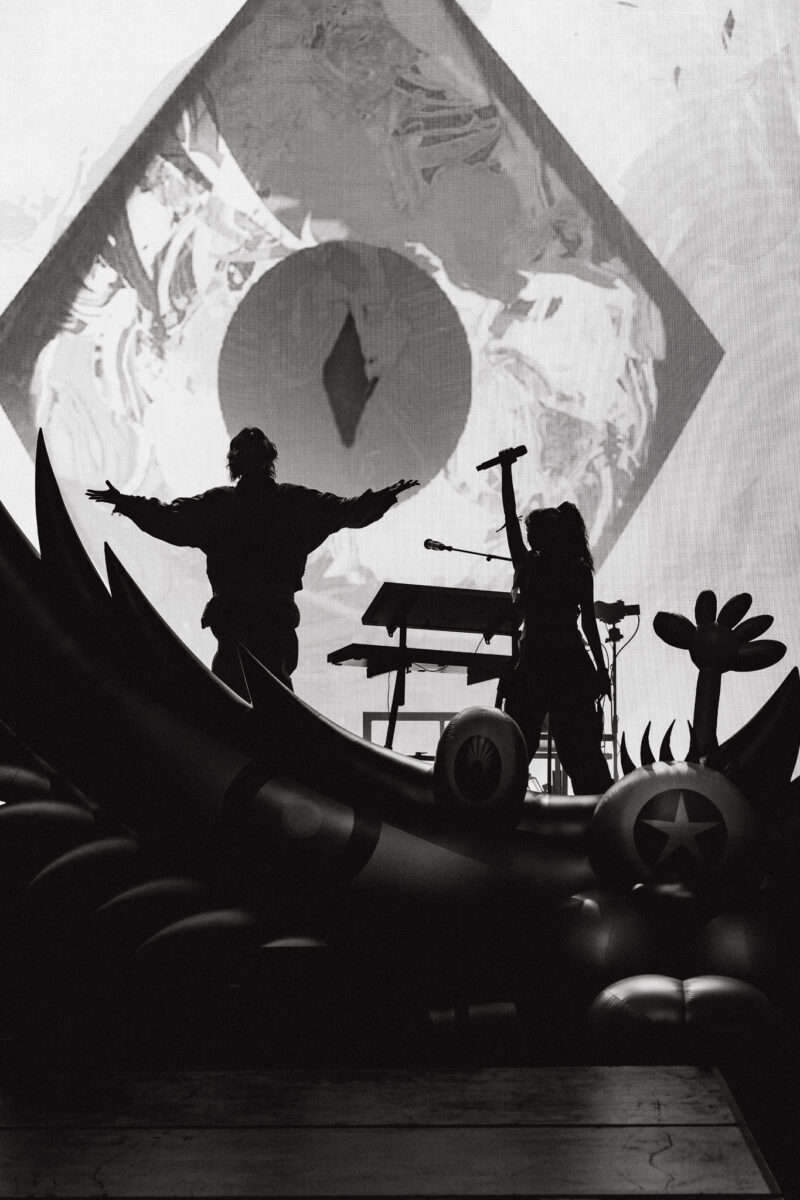

YOASOBI’s live shows are famous for their production value, and while Wembley did not give out glasses for their now-viral immersive segment, the concert more than delivered. Dizzying strobe lights, intricately animated visuals, and a massive structural dragon loomed over the stage, capturing the spectacle fans had come to expect.
While their earliest hits built a loyal fanbase at home, it was “Idol” — the propulsive theme song for the hit anime Oshi no Ko — that cracked something open globally. I met a pair of lads in their early twenties, one local and one visiting from Scotland, who only knew the band through anime. “We saw the show was happening and thought, why not?” one said. Ayase remembers that shift clearly. “As we kept going [after “Idol”], we started thinking that maybe we could do things no one had done before on a global scale. When we saw people all over the world listening, and [the song] charting overseas — it felt like we had opened a new door.”
That ambition ripples through their stagecraft, too. At Wembley, Ayase stood high above the stage on a raised platform, moving between the many components of his multi-elemental rig — a setup he affectionately calls “his fortress.”
Several rings glint off his hands as he lists off his gear: a MacBook for ambient layers, a sampler, two keyboards (“a single one can’t handle all the piano lines I write”), and drum pads for what he calls the “big, impactful sounds — like a boom!”


“I’m like the conductor, overseeing everything,” the 31-year-old says with a grin. “Rather than bouncing around the stage, I stay steady and make sure I’m always aware of everyone’s playing. That way, everyone else can move around freely.”
That freedom belongs mostly to ikura, who shouldered the spotlight with a presence that’s equal parts fierce and effervescent — punching the air during crowd chants one moment, and slipping into soft stillness the next.
ikura giggles when I hazard a guess that her real persona seems much more reserved than her stage one. “People think that because a lot of my hobbies — like reading manga, reading books, going on quiet walks — are hobbies I can do alone,” says the 24-year-old. “But when I’m with people or just in everyday life, I think I’m still the same happy person you see on stage.”
On stage, however, she admits she has to step up her energy to embrace the crowds. She describes Wembley as a space so charged it demanded a kind of vocal reckoning “I tell myself I need to sing with an energy that not only matches their power but completely envelops them.”
That desire to connect came through in one of the night’s most tender moments. Midway through the set, ikura pulled out a letter. “When I was 14, I knew I wanted to be a musician and started playing on the street with my guitar,” she read. “No one paid attention to me. Even when I played small venues, only family and friends showed up. I was rejected by countless auditions.”
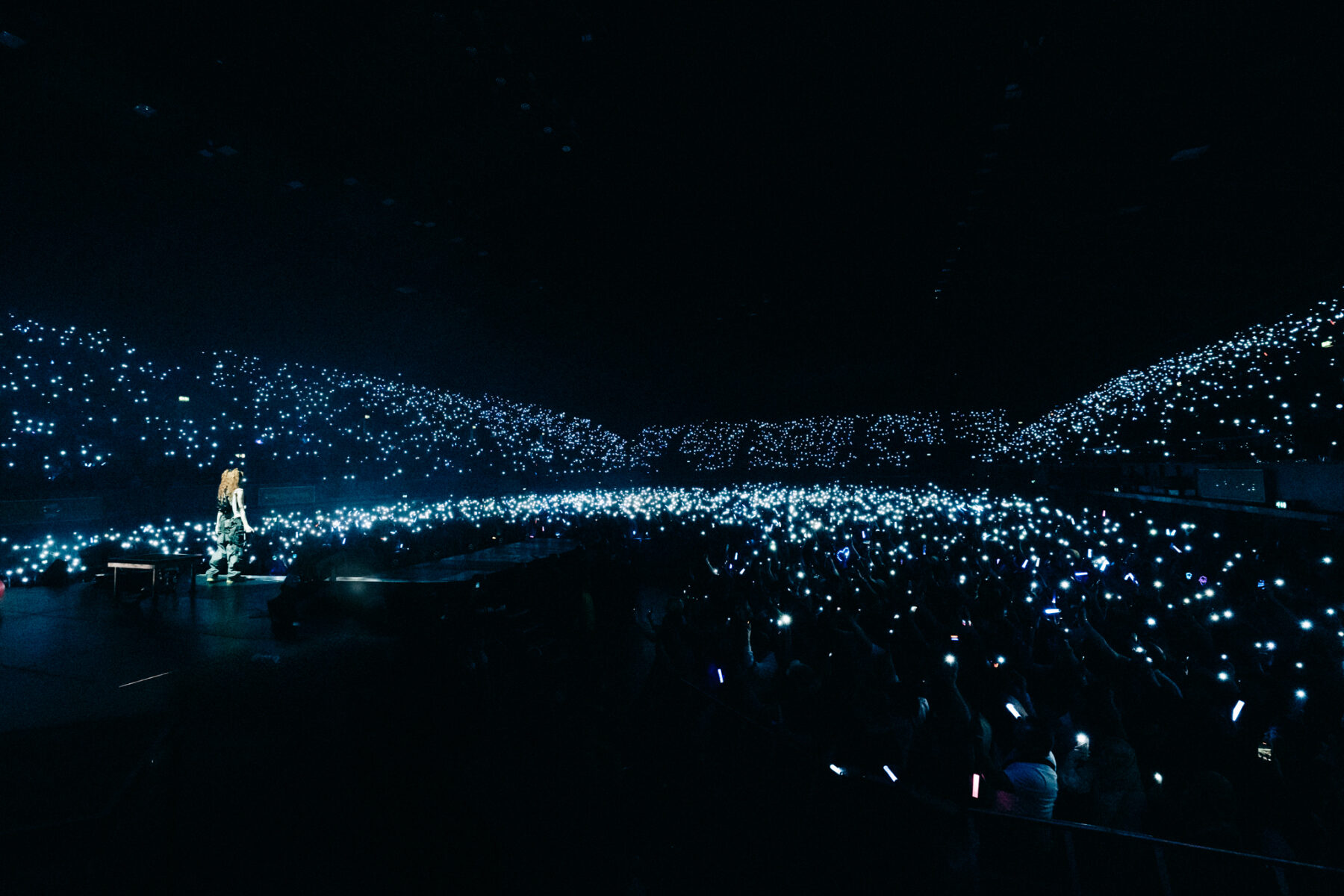
The crowd let out a collective “Aww,” prompting a mock sob from Ikura before she grinned and finished: “I never imagined that ten years later, I’d be here in London, so far from Japan, performing for 10,000 people!”
And that energy landed, at least according to Yukiko and Miyuki, two older Japanese women who I met after the performance. “It was more than what we were expecting,” Miyuki said with a wide smile. They hadn’t anticipated such a diverse crowd — cosplayers, Genshin Impact streamers, groups who’d flown in from Germany, Spain, Italy — but were moved to see how many people were singing along in Japanese. “I think music doesn’t really need the language,” she added, still a little awed.
In a way, that sentiment is the thesis of YOASOBI’s music: you don’t need to know the words to feel what they mean. And yet for those who want to go deeper, there’s plenty to uncover.
“A lot of our overseas fans say they started by just loving the melodies,” says ikura. “But then they begin reading the novels, even learning Japanese, to understand the lyrics better.” YOASOBI’s brand of music that works on first listen but deepens with context extends to their English versions too, translated by Konnie Aoki, a bilingual industry veteran who captures the nuance of the originals. “It’s incredibly difficult,” says ikura, “but he makes it feel natural.”
“Into the Night” even became a meme because of the stark contrast between its lyrics — based on a short story about a man trying to stop his girlfriend from taking her life — and its upbeat, addictive production.
That tension between sound and story played out in real time at Wembley. Even among the fans waving light sticks in sync, few were singing along to full verses — but almost everyone joined in for the calls and fist-pump chants, “hai!” ringing out across the arena. “We used to change our setlist depending on where we were,” Ayase explains. “But recently, we’ve stopped thinking like that. Now we just try to show the version of [ourselves that] we think is coolest.”
Their set ended not with a flashy final note, but a quiet moment of sincerity. After individual shoutouts to each band member, Ayase and ikura stayed till the very end of the credits, walking across the stage and bowing deeply in every direction. Ayase quips that it’s the only time he gets to be out of his fortress, but it’s also a show of respect rarely seen in artists at this level. “It’s just something we really want to do,” says Ikura, who closed every one of the 18 songs in their set with an earnest “Thank you so much!”
Even after shows at Coachella, Lollapalooza, Primavera, and a state dinner at the White House, YOASOBI remain understated in how they talk about success. “Each time we accomplish something, the next thing naturally comes into view,” Ayase reflects. “We don’t chase some giant goal. We just take the next step.”
For now, that might be a new story waiting to be turned into a song, a bigger tour announcement, or maybe even collaborations with British artists? “Anne Marie!” Ikura suggests immediately. “Bring Me The Horizon,” says Ayase steadfastly. “And While She Sleeps, I love While She Sleeps.” They confer for a second. “Ed Sheeran? Ed Sheeran, definitely,” ikura adds with a grin.
You heard them, Ed. Your move.
Live Photography – Tom Pallant
Words – Hannah Abraham


