Deft, daring and divisive, Cowards, the third album from art rock mainstays Squid is a record that digs into the worst of people and the best of musicianship. The British five-piece tell Ben Tibbits about their odyssey towards evil, finding a home with Warp Records, and their inability to sit still.

Evil. We live with it, struggle through it, dream of it. We hold its gaze, try to unlock its maze and helplessly watch it slither into our subconscious. It’s literal and it surrounds us—just look at what occurs in our broken utopia, each and every day. For Ollie Judge—songwriter, vocalist and drummer of swiftly seminal UK five-piece Squid—the grandiosity of tyranny set the tone for the writing of the band’s third album.
“It’s a funny time to write an album about evil,” he says. Its name, Cowards, was decided upon at a cafe a stones throw from the US embassy, much to the band’s future ironic enjoyment. “Strangely I didn’t think much about the world [right now] when I was writing it. It’s more a record based in fantasy, I guess.” And otherworldly it is; Judge’s tales of fictional sinners explore the deepest crevices of humanity’s darkness—the avarice and the apathy, the pusillanimity and the violence. He observes and depicts rather than casts judgement—he leaves that to the listener.
“It’s about how passive everyone has become to these topics,” the soft-spoken polymath reveals. “It’s omnipresent and it’s everywhere but we’re numb to it. And that can be funny in some ways, and it can be really horrible and depressing in other ways. I guess that comes across in the words. It’s about how consuming evil is, and how it’s not as simple as good or bad.”
Despite all that gentle nihilism, there is some good in the world—namely the charming boozer around the corner from the London office of the band’s label, Warp Records. The five revered musicians and I are sharing an early evening bitter, sheltering from the blustery mid-winter weather and talking about their tertiary full-length body of work.
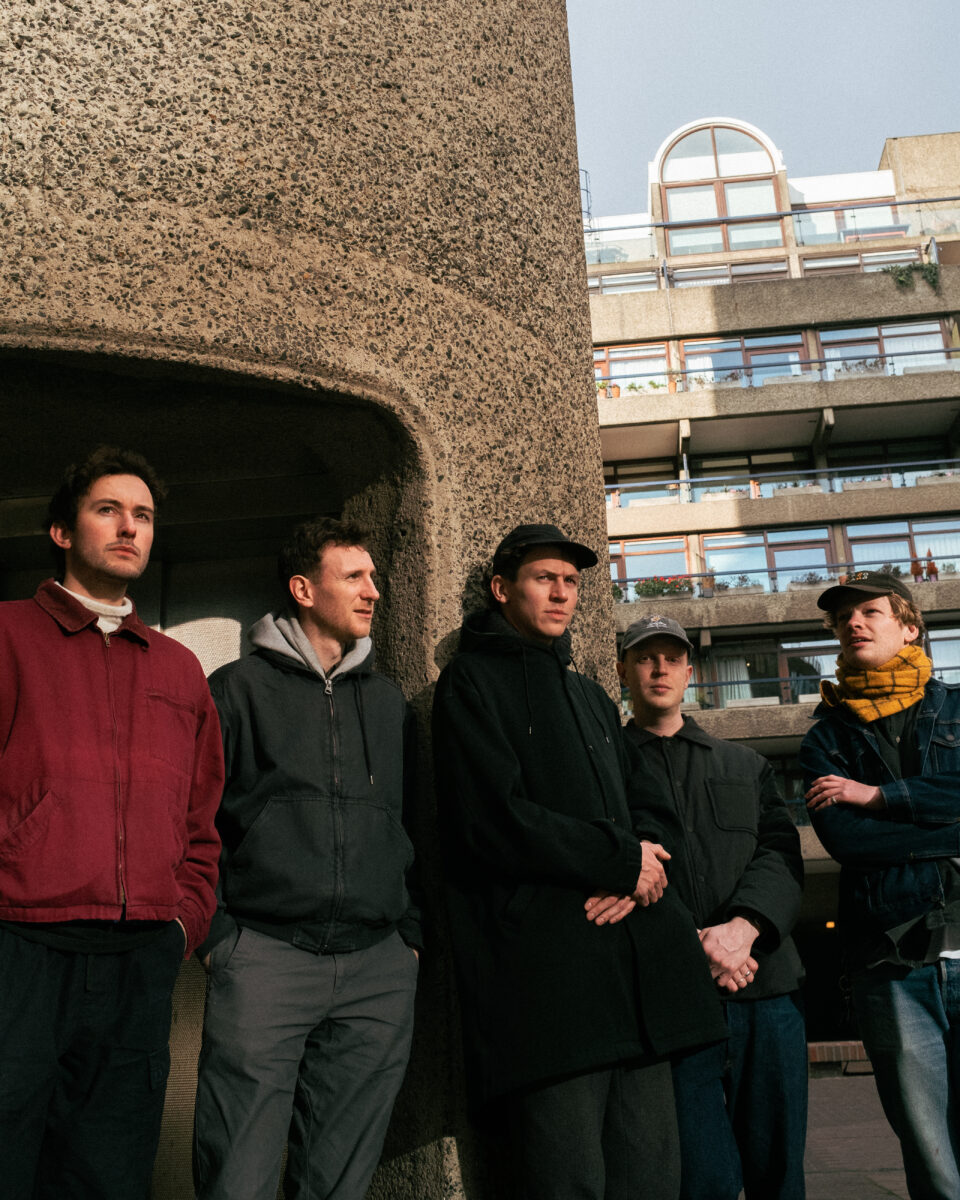

There’s no overt romanticism in the band’s origin story; fitting for an assembly of unassuming and art-driven auteurs whose rejection of industry rigamarole never feels fronted by pretension. Brighton natives (now London based by way of Bristol), bedroom scheming and sound sharpening grew to shows in front of their friends on the south coast. But it took a while for the band’s sonic prism to find its form, with five very different musical perspectives blending into a fruitful and flavourful formula.
“There was a really funny period where we didn’t know whether to stand up or sit down [on stage],” Anton Pearson, guitarist, jokes. “We were writing music that was ambient and quite heavy on the textures, but then we also started writing songs like [early cult favourite single] “The Dial”. So there was this funny in-between period, that was quite fun. Back then, we thought if we had two gigs in six months we were really busy.”
The boys’ view on the continuity of their live shows soon changed. Alongside contemporaries like Black Country, New Road and Black Midi, Squid were adopted into the famed Windmill movement. Against the backdrop of the Brixton venue during the mid-to-late 2010s, the scene saw post-punk revivalism truly come to a crescendo in parallel to the band’s breakout years, aided by South London alt saviours, imprint Speedy Wunderground. There, the band’s career began to mould into shape. “I remember there was that moment,” bassist Laurie Nankivell pinpoints. “When it went from being usually just our friends at gigs to one gig at the Windmill where there were a bunch of new faces. A big turning point I guess; people weren’t just there to be polite to us.“
Outrageous 2019 single “Houseplants”, a song that guitarist Louis Borlase specifies as “a springboard for us to become more widely known,” was followed by a critically adored, deafeningly creative EP, “Town Centre”. Less than a year later, Squid were signed to Warp and released their debut album, Bright Green Fields. “There were a few labels interested in signing us which was a really exciting and slightly stressful time,” Judge reflects. “We got a lot of free lunches and dinners though.”
“It was about us and the labels getting a feel for each other,” Louis adds on the difficult choice that has allowed them to flourish. “It was a really hard decision to make; it’s a family you’re about to join for the next however many years and months. But Warp just felt like the right fit—and it has been. They’ve been so accommodating about us making the music that we want to make.”
The outfit’s inaugural record was a towering success. A challenging cadence of stinging lyrical social commentary, visceral vocal performances and left-leaning art-rock and post-punk, Bright Green Fields’ structural sophistication is the work of a matured and well-practised ensemble, yet still raw and intrepid in its vision.
Squid toured heavily in the months that followed its release, before sharing a sophomore album O Monolith two years later. Recorded in Peter Gabriel’s Real World Studios in rural, bucolic Wiltshire, amidst runs of live shows, the work stepped ever further into experimentalism, with sonic themes of electronica and minimalism delved into across the 42 minute runtime. It feels, though, rooted in the natural world; a symphony of misguided beauty and climate anxiety. “The types of environments we were writing it in were quite different,” Pearson says. “It all felt organic and grounded, and there were themes from the local area that ended up feeding into the record.”
The year that followed O Monolith saw the band once again hitting the road for prolonged periods, unable to muster the time for new music. When a writing window finally did open and the band found themselves in Warp Studios, “itching to write some music,” they created in the most high stakes manner yet. “We all individually had mini meltdowns questioning why we were doing it,” Pearson chuckles on the band’s decision to make an album in six months. “Like, ‘We’re never going to get an album done in that time.’ But we did, and here we are, two years later.”
Made across Falmouth, Margate, London and more in short sharp bursts, with Italian production virtuoso Marta Salogni at the helm, the process was a test of will and fortitude, but one which eventually gifted the band their most cohesive work to date. “I think we’ve probably all got different opinions,” Borlase begins coyly on the process. “Having to deal with that time pressure was something difficult. We knew we needed to get it done by a certain time because we had touring commitments that we had to get back to. But there were certain pieces of music that felt like as soon as they’d begun, they were on a nice path to being completed without too much overthinking from us. There were some natural moments in the songwriting that were quite unique.”
Squid avoid conversations about influence where they can—as we all know, “there’s a lot of retro mania around at the moment which can be a bit iffy,” Borlase says. But they label Kate Bush and Talk Talk as stain-glass inspirations for Cowards, more so in a core credo to keep surprising their listeners. “People thinking that they’re one thing in their career and then them having a mad left turn and being more experimental,” Judge explains. “That’s something we appreciate.”
Squid’s whole discography nestles in the avant-garde, and Cowards is no different. It steers away from the unsettling synths and glaring off-kilter textures that set the timbre of O Monolith; but the greater focus on acoustic-driven instrumentation results in no less an idiosyncratic palette. They borrow the nuance of fellow Warp signee Clarissa Connelly and art pop artist Tony Njoku for contributions, whilst the band sound as accomplished as individuals and as a collective as ever. “The only ambition that I ever have is to push myself to do something new for me,” keyboardist Arthur Leadbetter says. “I think that’s the same for all of us. We don’t really think outside our circle.”
Judge’s sinister and dystopian tales of the normalisation of cannibalism, the media’s obsession with bloodlust, and the moral uncertainty of everyday existence are broody and bohemian, fascinating and terrifying; the full spectrum of evil . It’s an objective that most bands would be laughed out of, but Squid pass their boldest crossroads with flying colours.
Squid push boundaries with refreshing rarity, nonchalantly intellectual in the psyche of artistry. They’re currently touring the album, with an Oxford show tonight (27th February) and dates in Birmingham, Bristol and London—and a European stint—still to come. After that? The band has no idea. They’re living the moment, and hitting new peaks at every milestone. And what more could we, or they, ask for?
“We don’t speak much about ‘where we want to be in five years time’ and stuff like that,” Pearson concludes, as the others nod in ardour. “We just crack on with it. If we want to do something one year, we just go for it basically. It’s really hard to make a living from music, so we’re not taking it for granted, and we know it’s not necessarily going to last forever in this way. Basically we’ve got a year planned, lots of great shows, and have no intention of stopping. We’ll just see how we go.”
Listen to Cowards…
Words – Ben Tibbits
Photography – Zac Mahrouche


